
Industrial Valve Procurement Checklist for Plant Managers and Engineers
In an automated production line, a small electrical signal can determine whether water enters a cleaning circuit, compressed air reaches an actuator, or a process liquid moves to the next stage. A solenoid valve makes this controlled switching possible. It combines an electromagnetic coil with a valve mechanism to start, stop or direct the flow of a compatible fluid or gas.
Solenoid valves are widely used where remote operation, repeatable switching and integration with control systems are important. Understanding their construction and operating behaviour helps plant engineers choose a valve that matches the medium, pressure, temperature and duty cycle of the application.
What Is a Solenoid Valve?
A solenoid valve is an electromechanically operated flow-control device. When its coil receives an electrical signal, it creates a magnetic field that moves a plunger or armature. This movement changes the position of a sealing element, opening or closing a flow passage. When power is removed, a spring or another mechanism returns the valve to its designed rest position.
A solenoid valve is generally used for on/off or directional control; it should not automatically be treated as a precision throttling valve. The correct design depends on whether the system handles air, water, oil, steam or another medium, and on the valve’s approved material and operating limits.
How Does a Solenoid Valve Work?
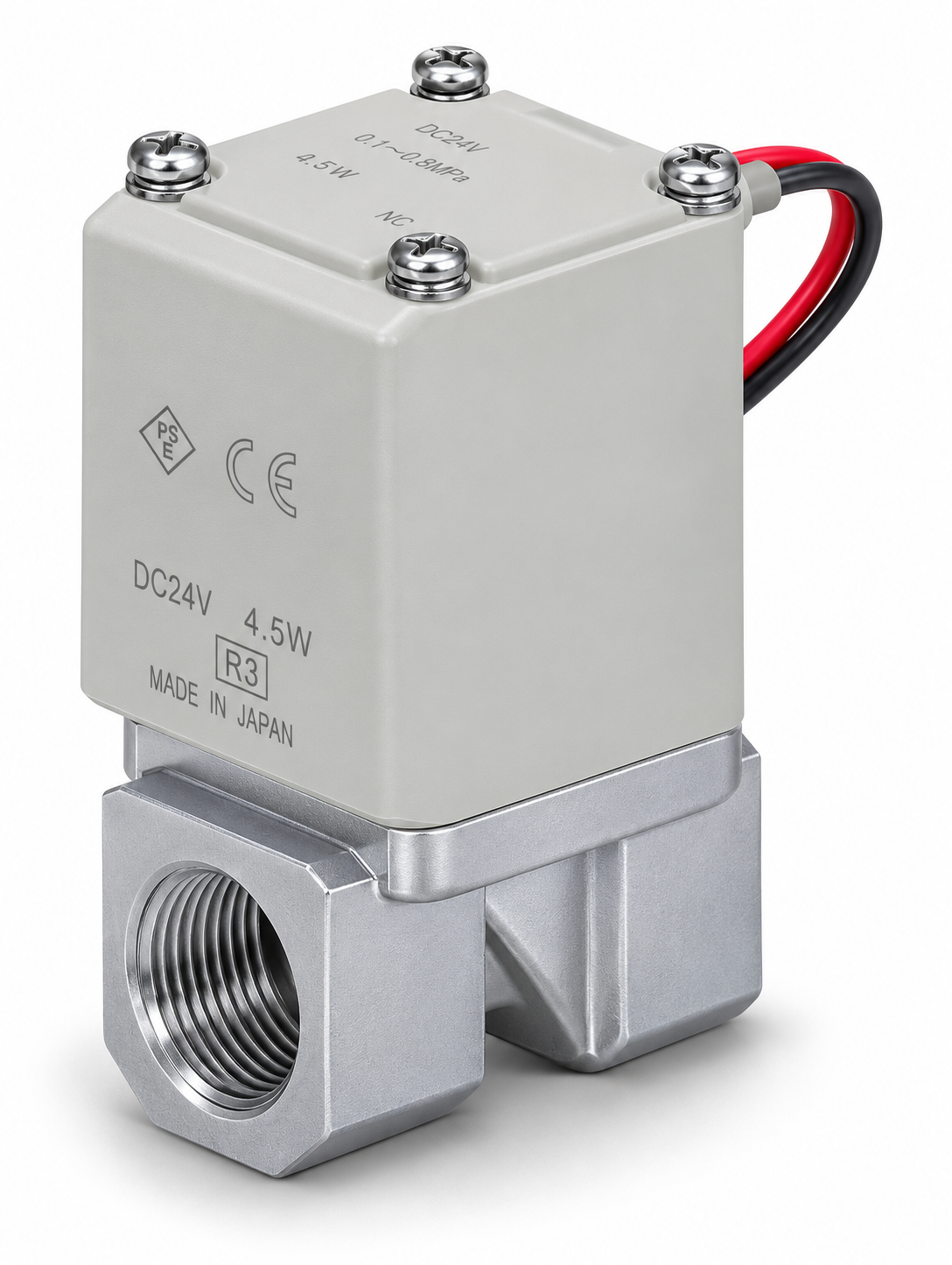
The operating sequence is straightforward, but the exact mechanism varies by design:
- Electrical command: A controller, relay, PLC or switch supplies the specified voltage to the coil.
- Magnetic field: Current through the coil generates a magnetic field around the armature assembly.
- Plunger movement: The magnetic force moves the plunger against the return spring or other opposing force.
- Flow-path change: The movement lifts or seats a seal, or operates a pilot passage that controls the main opening.
- Return to rest: When the electrical signal is removed, the valve returns to its de-energised position if it is a spring-return design.
Main Components of a Solenoid Valve
- Solenoid coil – The electrical winding that produces the magnetic field.
- Plunger or armature – The movable magnetic core that transfers the electromagnetic force.
- Return spring – Restores the moving element when the coil is de-energised in spring-return designs.
- Valve body and ports – The pressure-containing housing and the inlet, outlet or directional connections.
- Seat and seal – The sealing interface that controls leakage through the flow passage.
Types of Solenoid Valves Used in Industry
1. Direct-Acting Solenoid Valves
In a direct-acting design, the electromagnetic plunger acts directly on the main orifice. The valve does not depend on line pressure to move the main sealing element, so suitable models can operate at zero pressure differential. These valves are often selected for compact circuits, smaller flow passages and applications where the available pressure difference is low. Their allowable pressure, flow capacity and coil duty must still be checked.
2. Pilot-Operated Solenoid Valves
A pilot-operated valve uses a small solenoid-controlled pilot passage to control pressure acting on a diaphragm or piston. The process pressure then assists in opening or closing the main valve. This arrangement can handle larger flow capacities without requiring the coil to move the main element directly. Many designs require a minimum operating pressure differential, so they are unsuitable for some zero-pressure or very low-pressure circuits.
3. Semi-Direct or Assisted-Lift Designs
Some constructions combine direct mechanical action with pressure-assisted operation. They are intended to bridge the gap between conventional direct-acting and pilot-operated designs. Their operating envelope is model-specific; refer to the manufacturer’s technical data rather than assuming all assisted-lift valves behave identically.
Solenoid Valve Configurations: Normally Closed, Normally Open and Ported Designs
Normally closed (NC) describes a valve that blocks flow when the coil is de-energised and opens when energised. Normally open (NO) describes the reverse arrangement. The choice should reflect the required safe state during power loss, not simply the preferred control logic.
Valves are also described by the number of ports and flow paths. A 2-way valve typically opens or closes one flow path; 3-way designs can switch, divert or mix flow depending on port arrangement; and 4-way or 5-way valves are commonly used to direct compressed air to pneumatic actuators. Port labels and symbols should be checked on the manufacturer’s drawing before installation.
Direct-Acting vs Pilot-Operated: At-a-Glance Comparison
| Feature | Direct-Acting | Pilot-Operated |
| How it opens | Coil moves the main plunger | Pilot pressure moves main diaphragm/piston |
| Pressure differential | Can operate at zero differential* | Usually needs minimum differential* |
| Typical fit | Smaller flow paths / compact systems | Larger flow capacity |
| Main advantage | Simple, responsive operation | Lower coil force for larger orifices |
Where Are Solenoid Valves Used?
- Food and beverage processing: Automated water, air and compatible product-fluid circuits, subject to hygienic design and material requirements.
- Pharmaceutical manufacturing: Utility and process-support systems where controlled switching and documented compatibility are required.
- Water treatment: Actuation of selected water, air and chemical-dosing lines when the valve materials suit the fluid.
- Chemical processing: Remote switching of compatible liquids or gases after checking corrosion resistance and seal compatibility.
- Pneumatic automation: Directing compressed air to cylinders, grippers and other automated equipment.
- General manufacturing: Machine cooling, lubrication, washing and other repeatable on/off operations.
How to Select the Right Solenoid Valve
A valve that fits the pipe may still be unsuitable for the process. Before ordering, review the following points with the system designer or valve supplier:
- Media: identify the exact liquid or gas, including concentration, cleanliness and any suspended particles.
- Pressure: confirm inlet pressure, outlet pressure, operating differential and the minimum differential required by pilot-operated models.
- Temperature: check both media temperature and ambient temperature against the body, seal and coil ratings.
- Materials: match the body, plunger assembly and elastomers to corrosion, hygiene and compatibility requirements.
- Electrical supply: verify AC or DC voltage, frequency, power consumption, connector and enclosure protection.
- Flow and connection: size the valve using required flow, pressure drop, port size and connection standard—not pipe diameter alone.
- Duty and safety: consider switching frequency, continuous energisation, response needs, fail position and any hazardous-area certification.
Installation and Maintenance Considerations
Follow the flow-direction arrow and mounting instructions supplied for the specific model. Where required, install a suitable upstream strainer to reduce the risk of debris reaching the seat or pilot orifice. Confirm that the electrical supply matches the coil rating and that wiring, earthing and enclosure protection meet site requirements. Before maintenance, isolate electrical power and depressurise the line using the plant’s approved safety procedure.
If a valve becomes noisy, overheats, leaks or fails to switch, investigate likely causes such as incorrect voltage, contamination, a damaged seal, coil failure or operation outside the rated pressure range. Do not increase voltage or dismantle a pressurised assembly to force a response. Use the manufacturer’s inspection and replacement guidance.
Frequently Asked Questions
Q – What is the main function of a solenoid valve?
A – It uses an electrical signal to open, close or redirect the flow of a compatible liquid or gas.
Q – Does a solenoid valve need electricity to remain open?
A – It depends on the design. A standard spring-return valve changes state when energised and returns when power is removed; latching and other designs behave differently.
Q – What is the difference between normally closed and normally open?
A – An NC valve is closed when de-energised, while an NO valve is open when de-energised.
Q – Which is better: direct-acting or pilot-operated?
A – Neither is universally better. Direct-acting models suit applications that need direct plunger operation, including some zero-differential conditions; pilot-operated models can support higher flow where the required pressure differential is available.
Q – Can solenoid valves control air and water?
A – Yes, if the selected valve is rated for the medium, pressure, temperature and operating conditions.
Q – How do I know which solenoid valve size I need?
A – Use the required flow rate and allowable pressure drop, then verify the valve’s flow coefficient, port size, pressure range and connection details with its datasheet.
Conclusion
Solenoid valves connect electrical control with dependable fluid handling. Their value lies in repeatable switching and easy integration into automated systems, but reliable performance depends on selecting the correct operating principle, fail position, materials, pressure range and electrical specification. A direct-acting valve may be the right answer for one circuit, while a pilot-operated design may better suit another. Reviewing the process conditions before selection helps reduce leakage, avoid premature failures and support consistent plant operation.
Choose the Right Flow-Control Solution with Parth Valves
Parth Valves and Hoses LLP offers a range of industrial and hygienic flow-control products, including solenoid valves, actuators, butterfly valves, ball valves, diaphragm valves, non-return valves and FDA hose assemblies. If you are specifying a valve for a new installation or reviewing an existing process line, share your medium, pressure, temperature, flow requirement and connection details with the team.
Explore: Parth Valves product catalogue | Contact Parth Valves
Enquire with Parth Valves and find a flow-control solution suited to your process.