
Valve for CIP and SIP Systems in Pharmaceutical Plants
In a pharmaceutical plant, a valve is more than a flow-control device. It is a potential contamination point. When cleaning-in-place (CIP) and sterilising-in-place (SIP) must prove a line is clean and sterile without dismantling it, the wrong valve can trap residue, harbour bacteria and fail an audit. This guide explains how to select the right valves for CIP and SIP systems with confidence.
What CIP and SIP Demand from a Valve
CIP circulates cleaning solutions such as caustic and acid through process lines. SIP then sterilises the same lines, usually with saturated steam. Your valve must handle both repeatedly without leaking, corroding or shedding particles.
Typical Operating Conditions
The valve sees hot caustic, acidic rinses, purified water and clean steam, often in rapid sequence. That means repeated thermal cycling, so both materials and seals must tolerate expansion, contraction and chemical exposure.
Why Thermal Cycling Is the Hidden Risk
Steam at around 121°C to 135°C followed by a cool rinse stresses elastomers and joints. Seals that harden or crack create crevices where product and microbes collect.
6 Factors for Choosing Valves in CIP and SIP Systems
1. Hygienic Design and Drainability
Choose designs with no dead legs and full drainability. Liquid left behind after cleaning is where contamination begins. Install valves in a self-draining orientation and keep branch lengths as short as practical, following the guidance of ASME BPE for bioprocessing equipment.
2. Valve Type
Diaphragm Valves
The industry standard for pharmaceutical service. The diaphragm isolates the stem and actuator from the process fluid, giving a crevice-free, easily cleaned flow path.
Sanitary Ball Valves
Offer fast shut-off and low pressure drop. Choose cavity-filled or full-drain designs so product and cleaning fluid cannot get trapped.
Butterfly Valves
A cost-effective choice for large-diameter CIP return and water lines, provided the disc and seat are hygienic in design.
Check and Sample Valves
Sanitary check valves protect against backflow, and dedicated sample valves allow aseptic sampling without breaking containment.
Browse our sanitary and industrial valve range at Parth Valve to compare options for your process.
3. Material and Surface Finish
Specify 316L stainless steel for its corrosion resistance and low carbon content. Finish matters just as much as grade: electropolished internal surfaces with a low roughness value (Ra) resist fouling and make cleaning easier. Always request material certificates and surface-finish reports.
Image suggestion: macro of an electropolished valve body interior. Alt text: electropolished 316L stainless steel valve surface.
4. Seals and Elastomers
Seals are the most common failure point in SIP. Match them to your cleaning chemicals and steam exposure.
| Seal Material | Strength | Typical Limitation |
| EPDM | Excellent steam and caustic resistance | Poor with oils and solvents |
| PTFE | Chemically inert, wide temperature range | Can cold-flow under load |
| Silicone | Flexible, good for lower temperatures | Weaker steam durability |
| FKM (Viton) | Good oil and solvent resistance | Limited with hot caustic and steam |
For most CIP and SIP lines, EPDM or PTFE (often as a PTFE-faced EPDM diaphragm) gives the best balance.
5. Automation and Control
Pneumatic actuators with position feedback let the control system confirm valve status during CIP and SIP cycles. Automated sequencing improves repeatability and creates the data trail that auditors expect.
6. Compliance and Documentation
Pharmaceutical valves must support cGMP expectations from regulators such as the U.S. FDA. Ask for material traceability, pressure-test reports, surface-finish data and validation support. A manufacturer with ISO 9001 systems makes qualification far easier.
Temperature Profile a Valve Must Survive
The chart below shows approximate temperatures a CIP and SIP valve meets during a typical cycle.
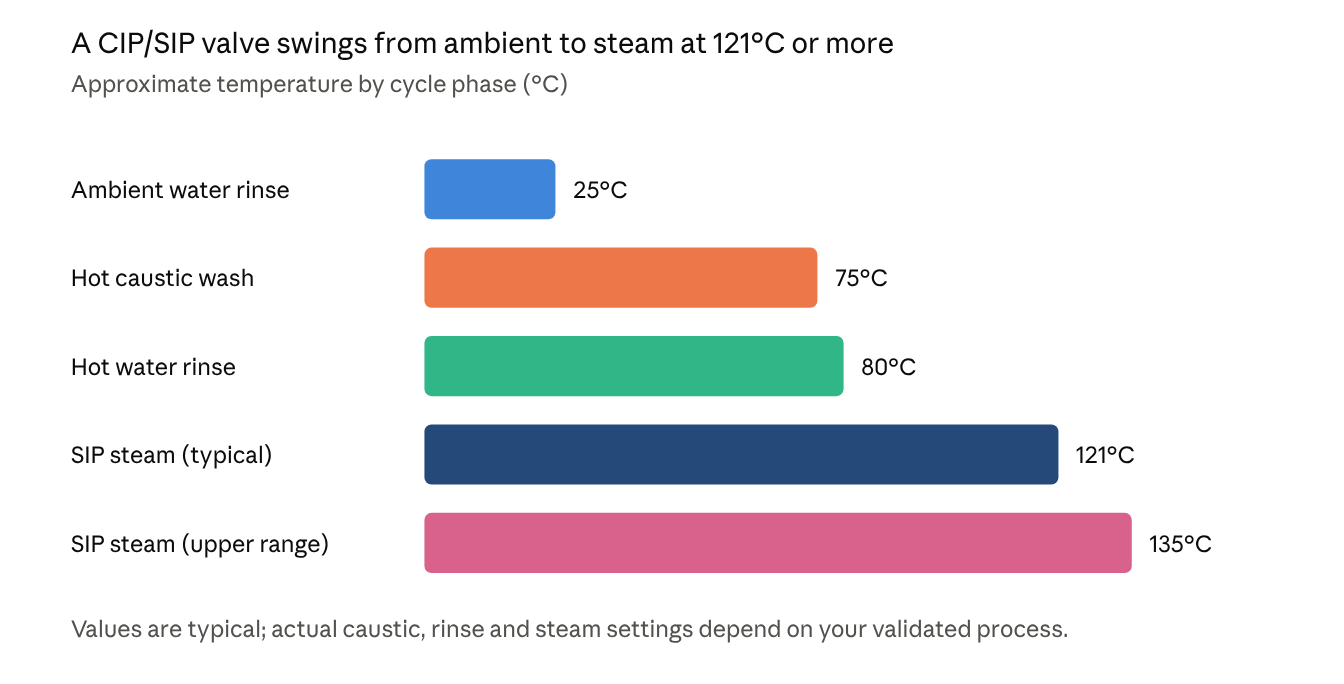
Approximate typical values; confirm against your validated CIP/SIP parameters
Quick Selection Guide
| Application | Recommended Valve | Key Feature |
| Product transfer lines | Diaphragm valve | Crevice-free, drainable |
| Large CIP return lines | Hygienic butterfly valve | Cost-effective, low pressure drop |
| Fast on/off isolation | Sanitary ball valve | Full-drain design |
| Backflow protection | Sanitary check valve | Protects upstream equipment |
| Aseptic sampling | Sample valve | Maintains containment |
Installation and Maintenance Tips
- Install valves so lines drain fully after CIP
- Replace diaphragms and seals on a validated schedule
- Avoid over-tightening clamps, which damages gaskets
- Document every change for audit readiness
- Keep critical spares on site
Conclusion
Selecting valves for CIP and SIP systems means balancing hygienic design, the correct valve type, 316L construction with a fine finish, suitable seals, automation and full documentation. Get these right and you reduce contamination risk, shorten cleaning cycles and pass audits with confidence. Work with a manufacturer that understands pharmaceutical requirements from the start.
Need Valves for Your Pharmaceutical Process?
Speak with the team at Parth Valve. Share your line size, media, temperature and compliance needs and receive a tailored recommendation and quote. Contact us today to get started.
Frequently Asked Questions (FAQs)
What is the difference between CIP and SIP?
CIP cleans process equipment without disassembly using cleaning solutions, while SIP sterilises it, usually with saturated steam.
Which valve is best for pharmaceutical CIP and SIP systems?
Diaphragm valves are the most common choice because their crevice-free design is easy to clean and sterilise.
Why is 316L stainless steel used in pharma valves?
Its low carbon content and corrosion resistance make it suitable for repeated cleaning chemicals and steam exposure.
Which seal material suits SIP service?
EPDM and PTFE are widely used because they tolerate steam and caustic cleaning agents well.
How often should valve seals be replaced?
Replace them on a validated preventive-maintenance schedule based on cycle count, temperature and chemical exposure.