
FDA Hose End Fittings: Types, Materials and Selection Guide
A food-grade hose is only one part of a hygienic transfer assembly. The connection at each end matters just as much. An unsuitable fitting, incompatible gasket or poorly assembled joint can create leakage points, retain product residue or make cleaning difficult. In food, beverage, dairy and pharmaceutical operations, choosing the correct hose end fitting is therefore a process-design decision—not simply a matter of matching the pipe size.
FDA hose end fittings are commonly discussed in the context of components intended for food-contact applications. The phrase is often used commercially, but buyers should verify the actual regulatory basis and documentation for the complete wetted assembly. This guide explains the main connection styles, material considerations and practical checks to make before specifying a fitting.
First, What Does “FDA-Compliant” Mean?
The US Food and Drug Administration regulates substances and materials used in food-contact applications through specific authorisations and conditions of use. A material is not suitable for every food, temperature or cleaning condition simply because a supplier describes it as food grade. Compliance depends on the substance, formulation, intended conditions of use and applicable regulatory provisions.
For example, US regulation 21 CFR 177.2600 addresses rubber articles intended for repeated use in contact with food, subject to stated requirements. The FDA also explains how manufacturers determine the regulatory status of food-contact components. Buyers should request documentation for the actual product-contact material and confirm that its conditions of use match the process.
Common Types of FDA Hose End Fittings
Different plants use different connection systems. The best option depends on the equipment interface, cleaning method, required frequency of disconnection and the relevant dimensional standard.
1. Tri-Clamp or Sanitary Clamp Fittings
Tri-Clamp-style connections use matching ferrules, a gasket and a clamp to create a removable joint. They are popular in hygienic process lines because operators can open the connection for inspection, cleaning or product changeover. The ferrule dimensions, gasket profile and clamp must belong to the same compatible standard and size.
2. Dairy Union Fittings
Dairy union connections, including systems made to standards such as DIN 11851, are used in milk and food-processing installations. Their threaded union nut compresses a sealing element between mating components. Do not assume that a dairy union and a clamp connection are interchangeable; check the exact standard, thread form and seal arrangement.
3. Hose Tail or Serrated Stem Fittings
A hose tail enters the bore of a flexible hose and provides a connection for an appropriate retention method. The stem profile and outside diameter must match the hose’s inside diameter and construction. The clamp or crimp system should be specified for the hose type and working conditions; an improvised clamp can damage the hose or allow the fitting to pull out.
4. Threaded and Flanged Adapters
Threaded and flanged ends are often used to connect a hose assembly to pumps, tanks, skids or fixed pipework. These interfaces are available in different standards and pressure classes. Confirm thread type, flange drilling, gasket arrangement, face finish and the rating of the connected equipment.
5. Quick-Connect and Camlock-Style Couplings
Quick-connect couplings can reduce connection time in suitable transfer duties. However, not every general-purpose quick coupling is appropriate for hygienic product contact. Check the wetted materials, internal geometry, seal, cleanability and documented suitability for the specific medium and cleaning regime.
Which Materials Are Used?
Material selection must consider both the fitting body and every component that touches the product, including the gasket and any internal insert. Stainless steel is widely used for hygienic fittings because it offers durability and corrosion resistance, while elastomers provide the seal. The right combination is application-specific.
Stainless Steel 304 and 316/316L
Stainless steel 304 is commonly used in food-processing equipment and offers corrosion resistance for many food and cleaning environments. Grade 316 contains molybdenum, which generally improves resistance to pitting and certain chloride-containing environments. 316L is a low-carbon version often specified for welded hygienic components. Neither grade is universally immune to corrosion: chemical concentration, temperature, exposure time and cleaning practice still matter.
Common Gasket and Seal Materials
- EPDM – Often considered for water-based products and cleaning conditions, subject to the specific formulation and temperature limits.
- Silicone – Used in many hygienic applications where flexibility and temperature capability are important; check mechanical and chemical limits.
- NBR – Can be suitable for selected oils and fats, but verify the exact compound and food-contact documentation.
- PTFE – Offers broad chemical resistance and is used in demanding process environments; design and sealing behaviour depend on the fitting.
A Quick Comparison Before You Specify
| Connection style | Typical use | What to verify |
| Tri-Clamp / sanitary clamp | Frequent dismantling, hygienic process lines | Ferrule standard, clamp size, gasket profile |
| Dairy union (e.g. DIN 11851) | Dairy and food transfer systems | Exact union standard, thread and seal |
| Hose tail / serrated stem | Flexible hose connection | Hose ID, stem profile, retention method |
| Flanged / threaded adapter | Equipment or utility interfaces | Pressure class, thread/flange standard, sealing face |
| Camlock / quick coupling | Fast connection in suitable transfer duties | Food-contact suitability, seal, service and risk assessment |
Remember: The table is a starting point for discussion. It does not replace the drawing, standard, pressure rating or material certificate for the selected fitting.
How to Choose the Right Hose End Fitting: A 7-Point Check
- Identify the product: Is the hose carrying milk, juice, syrup, edible oil, powder, pharmaceutical ingredients or a cleaning fluid? Product chemistry affects wetted-material choice.
- Confirm food-contact documentation: Ask for the relevant declaration, certificate or compliance statement for the exact fitting, gasket and hose assembly—not a generic brochure claim.
- Match the connection standard: Record the required clamp, dairy union, thread, flange or quick-connect standard, including dimensions and size.
- Check pressure and vacuum: Confirm working pressure, any suction/vacuum duty, surge conditions and the rating of the complete assembly.
- Review temperature and cleaning: Include normal operating temperature, hot-water washdown, CIP chemicals and any validated steam or sterilisation cycle.
- Specify surface and cleanability: For hygienic service, consider internal finish, crevices, dead spaces, drainability and ease of dismantling.
- Confirm assembly and traceability: Use a suitable assembly method and retain product identification, batch traceability and inspection records where required.
Where Are Hygienic Hose Fittings Used?
Food and beverage plants use hose assemblies for ingredient transfer, tank loading, product discharge and cleaning connections. Dairy facilities may need flexible connections around milk reception, pasteurisation, cheese production and filling equipment. Pharmaceutical operations can require documented materials and controlled cleaning practices for selected transfer duties. Each application has its own hygienic design and validation requirements.
Parth Valves and Hoses lists food-grade hose options in silicone, UPE, white EPDM, NBR and natural rubber constructions, with product-specific size and temperature ranges. Its application areas include food, dairy, beverages and pharmaceuticals. The fitting and hose should be specified together so that the complete assembly meets the process requirement.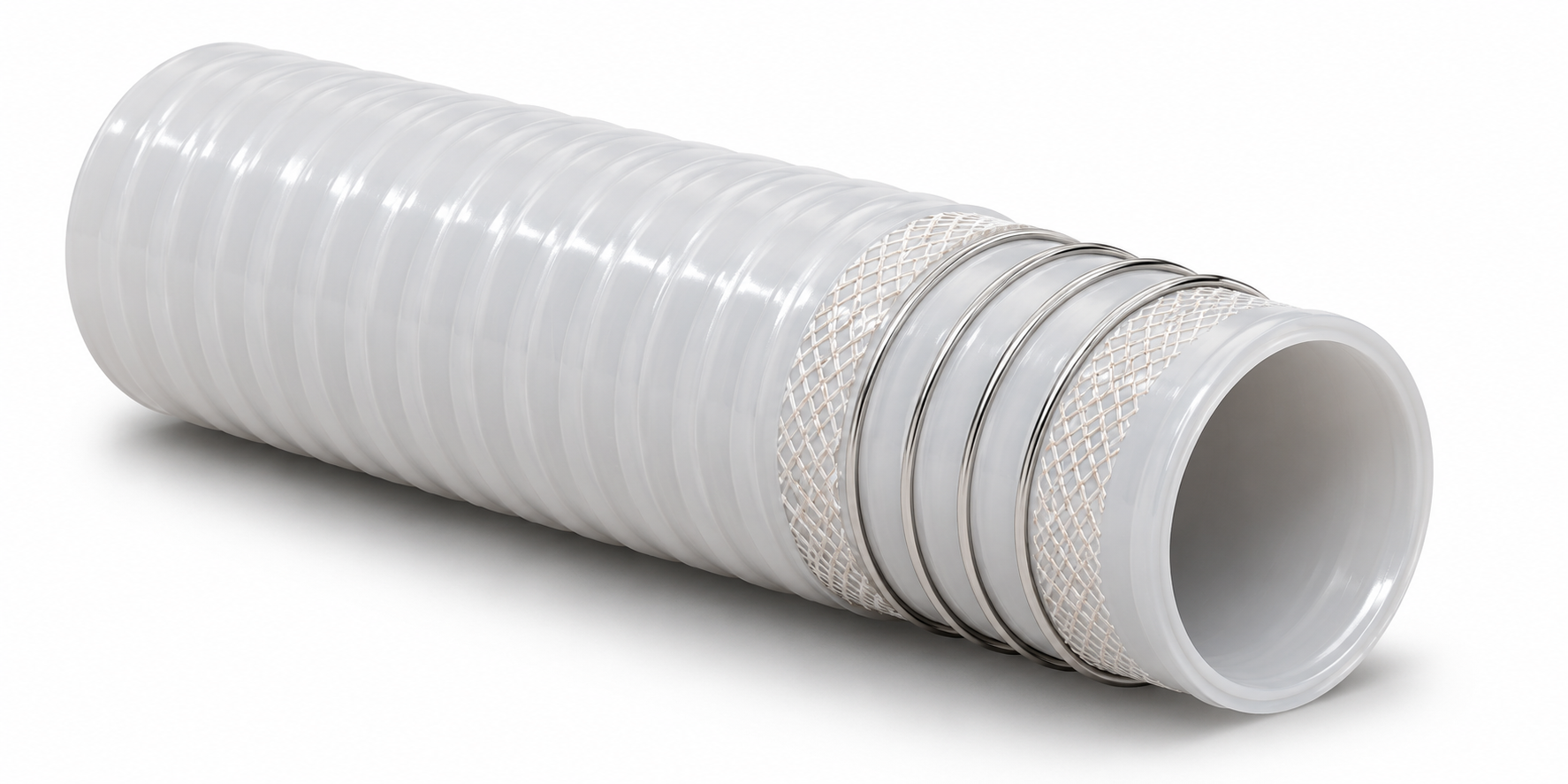
Explore Parth Valves’ food-grade hose range and industry applications for more information.
Frequently Asked Questions
Q – Are all stainless steel hose fittings FDA compliant?
A – No. Stainless steel grade alone does not establish food-contact compliance. The complete product-contact construction, surface condition, seals and intended use must be assessed and documented.
Q – Which stainless steel is preferred for hygienic hose fittings?
A – 304/304L and 316/316L are common choices. 316/316L may be preferred where greater resistance to pitting or chloride exposure is needed, but the process conditions determine the correct grade.
Q – Can I use a standard industrial hose fitting on a food-grade hose?
A – Not automatically. Confirm that the fitting and seal are suitable for food contact, compatible with the hose, cleanable and rated for the operating conditions.
Q – What is the difference between Tri-Clamp and a dairy union?
A – They are different connection systems with different geometry and sealing arrangements. They should not be treated as interchangeable unless a purpose-designed adapter is specified.
Q – Why does the gasket material matter?
A – The gasket is often in direct contact with the product. An incompatible seal can swell, degrade, leak or introduce contamination, so its compound and regulatory suitability must be verified.
Q – What information should I share when requesting a hose assembly?
A – Provide the product or fluid, hose ID and length, connection standards at both ends, operating pressure, temperature, cleaning method and any required certificates or traceability.
Conclusion
The reliability of a hygienic hose line depends on more than the hose material. End fittings, gaskets, connection standards, assembly methods and documentation all contribute to a safe and maintainable transfer system. By matching the fitting to the product, cleaning regime, pressure, temperature and equipment interface, plant teams can reduce leakage risks and make routine inspection and cleaning easier. Always evaluate the complete hose assembly rather than approving each component in isolation.
Find a Suitable Hose and Fitting Solution with Parth Valves
Parth Valves and Hoses LLP supplies industrial and food-grade hose options for applications across food processing, dairy, beverages and pharmaceuticals. Share your hose specification, connection type, process medium and operating conditions with the team to discuss a suitable configuration.
Discuss your hygienic hose requirements with Parth Valves.